A Framework for Innovation

Creating change. A fun subject, and an admirable goal according the American Ethos and the media our society has spawned. Even though the innovative ideas may go against the grain or the way that things are currently being done, many consider it a virtue to pursue
innovation-vs-no-innovation

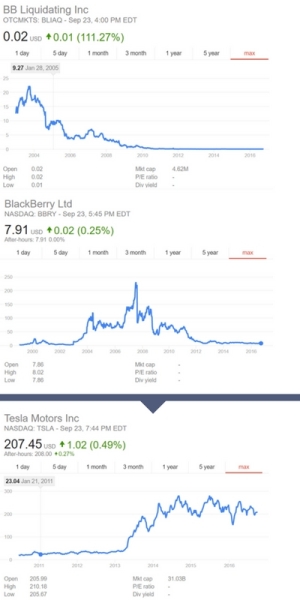
The macro effect of innovation on a company

them. With so much positive emphasis on innovation in our culture, why is it so difficult?

There thousands (if not millions) of reasons why this is the case and I couldn’t hope to answer in a short blog post. Looking at the reverse of that, “how do successful innovations occur?” many insights are available. There are many theories with many names, but reading many of these there is a correlation across the different materials which boil down to two things from what I’ve found and read.

  1. Let people know how the innovation will effect them
  2. Make things easy for the people who are going to be using the innovation

Switch lays out the best framework (in my opinion) for accomplishing these two goals.

Framework for Change

The basic idea is conveyed through the idea that every person can be pictured like a rider on a top of an elephant going down a trail. In order to change where the rider is going to end up, there is the ability to alter three things. You may have guessed it. We can change the rider, the elephant, and the trail.

The Rider: In the idea of the rider and the elephant, this is the logic. Everyone has logic (although some riders may be weaker than others) that helps to form how they behave. The rider’s the part of the person who when starting a new habit, like running in the morning, will cause people to set an alarm.
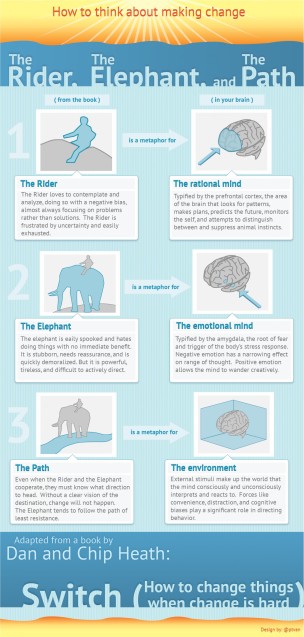
the-rider-the-elephant-and-the-path_50290b0771b02_w1500.pngThe Elephant: Emotions and subconscious drive. At the end of the day, the elephant dictates where the rider is going to go. The average ~150 pound rider will only be able to control a 13,000 pound animal for so long before coming exhausted.

The elephant is the reason why the planned morning run will be cancelled by multiple pushes on the snooze button. The  elephant is also the reason why people work 90 hour work weeks and are excited to do so.

The Path: The final component for creating change is the external environment in which every individual operates. These are the external forces which effect behavior. Shaping the external forces and how they act upon elephants and their riders, getting the rider to move towards the desired end location.


All in all, it’s pretty straightforward right? Well, it is definitely much easier to conceptualize and talk about then it is to implement. So many people fail, myself included, to implement all three at the same time, leading to great ideas being dropped to the wayside.

For those who want to change things for the better, hopefully this framework can help you get to actualization of innovation.

Visualization Exploration and Explanation

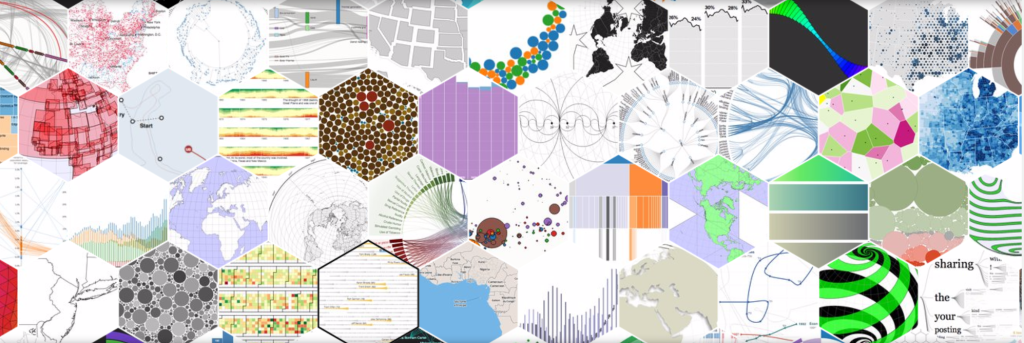
Recently I’ve been looking at the visualization tools that are available on the web, and noticed a distinct difference. A quick Google search shows that I am far from the first person to notice this idea. The basic concept, and what many have found before me, is that visualization’s fall under one of two categories, explanatory and exploratory tools.

Explanatory:

These are the visualizations that are used to illustrate an idea or result in a clear and concise way that removes the need for someone to be 100% familiar with visualization and data. The key? These answer “why” some statement, assertion, or idea is true. The best examples of these are the more advanced and complicated tools that are used to visualize complex ideas that may be hard to explain or illustrate by traditional means.


Exploratory:

Quick and fast to implementation generally. The analyst type visualizations. Think bar charts, simple line graphs…anything that has the goal of showing what is in the specific data set, and doesn’t answer why those data items are in the dataset. These generally answer the “what”. What is happening? Where are high cost goods going? These will be simple to create and illustrate. Think financial dashboards, and simple line and bar charts for the most part.

Why is this distinction important? Being extremely conscientious of what you are trying to do can help select tools, and define what is trying to be accomplished. When this distinction is made on what is trying to be achieved, the right tool and result can be created resulting in time not being wasted

Inspiration vs Manipulation

A few weeks ago I was lent a copy of the book Start with Why. The ideas around the use of manipulation vs inspiration to change human behavior is one of the ideas that struck a chord with me thus far. Looking at companies today, there is a clear differentiation in the way that organizations position themselves based upon where they fall with when using manipulation vs inspiration.

Inspiration

These are the companies that get the best employees, deliver innovative solutions, and much of the time have higher margins and growth compared to competitors. How is this achieved? You guessed it. They have a great and inspiring vision of why they do what they do.

spacex mission.PNG

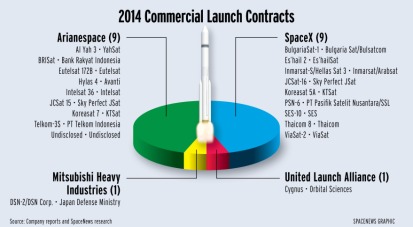
This vision and end goal above is lofty, and certainly something the people (especially rocket designers) can aspire to. Having such a vision for where the company is headed has apparently worked to Spacex’s advantage. Spacex has managed to steal significant market share from the much older Arianespace. There there must be something behind Spacex’s success.

commercial_launchers_web_1.12.151-879x485

The focus on a lofty vision of “why” an organization does what is does not only drives profits, but also clear and concise decision making and motivations for all who are involved with the company. Driving behavior towards a goal that is inspiring and internally motivated is much more effective in the long-term  compared to manipulations.

Manipulation

Price, promotions, fear, aspirations. These are the tactics that are potential changers of human behavior. When making use of these strategies, a company has most likely lost sense of why it exists. The reason for this? When a company is offering to cut price, or market to customer aspirations, there is no longer an internal motivating factor that drives the company. The company compass for decision making has been lost.

The great (or terrible depending on your perspective) example of this is General Motor’s use of promotions to drive sales. In the 1990’s General Motors, along with other US auto manufacturers relied on offering of sales incentives to retain market share when faced by an onslaught of foreign automakers. By taking this route, the US automakers effectively weakened their brands. This may have allowed the automakers to retain higher market share short-term, but it obviously didn’t help the long-term growth and profitability of the company.

Manipulations create addictions for companies that may create some short-term value, but it is at the expense of harming the organization in the long-term. The more fear, promotions, prices cuts, and aspirations a company uses to sell products the cheaper the brand perception will be.

Bottom line, knowing why a company exists provides in internal locus of control which has been proven to be a motivating force compared to the use of manipulations. There’s a reason that Apple customer’s pay more than a 20% premium compared to competitor products, and it’s due to knowing why.

Down with Vertical Database Architecture

The goal of gathering data can be broken down into a combination of any of the following free. Understanding what has happened, what is happening, or project what will happen. When getting answers to these questions, as long as the answer is obtained, why does it matter how the answer was obtained?

Getting a view into this information can be done many different ways, and with the products available on the market can be done for free and with minimal IT know how. There is a time and a place to pay a premium on IT projects to obtain the capabilities that Skyscraper_Diagramnone of your competitors will have. When a solution needs to be scale-able and tailored to your unique needs.

This is when architecture comes in.

Just like any structure, a database architecture can be flat or tall. What is the difference? To
run with analogy of comparing database architecture to buildings, a skyscraper (vertical) is much more complex to build and maintain compared to a house (horizontal).

Horizontal

A horizontal architecture can be pictured like a suburb. This translates to a house that is commissioned by you that is easily customizable and suited to your needs and wants. Do you want a pool? Easy. Do you want a larger living room or a smaller kitchen? That can be done.

Taking this analogy from building skyscrapers to databases, a flat architecture means that your data is displayed from a single (or as few as possible) levels. It is much easier to understand how the wiring, plumbing, lighting, etc. were put into a house when compared to a skyscraper. Additionally, when you want to install a pool, it’s much easier to install and maintain than a pool on the 23rd floor of a high rise.

Architecture Diagram

Vertical

A vertical architecture means many structural layers in the database, and with it comes complexity. The difference between the physical skyscraper and databases? Skyscrapers are generally created when there is no more land to build flat, this law of physics doesn’t apply to databases.

Why would anyone build a vertical architecture than? In my experience time and resource constraints effect (two thirds of the magic time-resource-quality triangle), short-term thinking.

Benefits of Horizontal

  1. Decrease in cost: Less people to maintain complex solutions, and more time spent creating value for you.
  2. Higher quality: More visibility into what is happening where. Instead of having to dive through and learn how everything was built, people playing with the data only have to learn specific portions which they are interested in.
  3. Faster delivery: The final win on a flat architecture, is speed of delivery. By reducing complexity people spend less time learning, and more time creating value. While in the immediate you may save time in the short-term with a vertical architecture, you will pay dearly in the long-term.

Social Media from the Seasoned

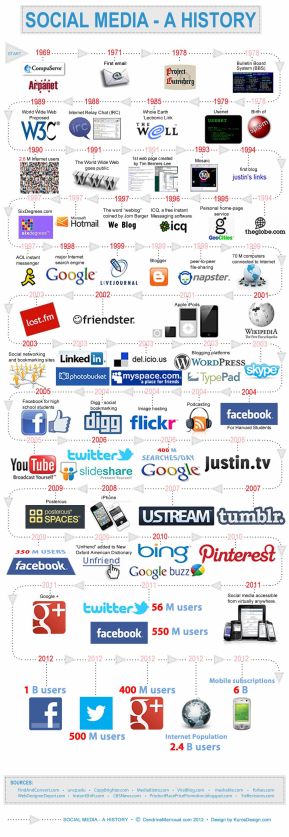
history-of-social-mediaHuman history began 4,000 BCE. Social media in its modern form? Started in 1997 with the site Six Degrees. Putting these two timelines together may seem ridiculous, and admittedly is a bit, but there is a point. With social media being such a recent innovation compared to many skills still heavily used and valued by society today, such as accounting, what can social media media professionals teach us about this roughly 20 year old skill set?

I’ve had the opportunity to hear from industry experts from McGarrah Jessee, Splash Media Group LLC, and other both large and small social media marketing firms. These individuals have covered everything from creating useful branded content to establishing client relationships (and more). Although a new field, there is definitely a large group of driven individuals working towards continuously evolving and growing the usefulness of social media for business. I’m going to attempt to encapsulate a few of the important points at an extremely high level.

Biggest Applicable Advice

When interacting with people on a day to day basis, what do you prefer? A person who talks about themselves and what they have accomplished, or people who provide valuable advice and interesting conversation? Well, social media experts have realized that businesses can create a relationships with people that represent the latter through content marketing.

Content marketing seems to be a phrase that all of these social media professionals, across multiple industry and business sizes, have been repeating or hinting at. “Make it interesting” or “Make your content something people want to read”. With the deluge of ads that people see everyday, and the myriad of ways to avoid seeing these adds, advertisers now have to convince people that they want to spend time looking at ads. This same concept can be applied everywhere.

Whenever communicating with others, be genuine, interesting and most importantly create value so that people want to listen. Sticking with these pillars can go a long way.

The days of useless and noisy banner advertising are over.

Attributes of Social Media Professionals

There seem to be two types of primary skills that are needed to be successful at social media marketing. The first, an analytical ability to extrapolate data into stories and actionable items for advertising. What do I mean?

Building profiles of the target customer, measuring what works and what doesn’t, basically collecting every piece of data that is available and having the ability to develop strategies around these data points. Looking at Hops and Grain, a local brewery, the social media strategist has been able to learn from data and create a social media profile and brand that people find interesting and go out of their way to view.

Looking at the below pictures can you see a common theme? Outdoorsy, lifestyle type photos that sneak in the beer and branding into the picture in somewhat subtle ways.

Hops and Grain insta.PNG

The second major attribute I noticed was that all of the individuals, no matter how data driven they are, seem to be creatives. What I mean is that these professionals love coming up with new and clever ideas.

This seems to be needed due to social media being a medium that can produce widely varied results. Content must be instantaneous, in the moment, and clever, or risk becoming a Red Lobster. If a professional can’t come up with new ideas that capture people’s attention, success in social media is unlikely.

Quick Takeaways

  1. At the end of the day, using social media as a microphone doesn’t work.
  2. Be consistent online (and in life)…but really, nothing disappears once it’s online.
  3. Don’t feed the trolls. There are toxic followers, just like their are toxic customers. Be aware of who with and how you’re spending time on social media.

After hearing these different speakers, I don’t have plans to apply these learnings directly on pursuing a career in social media. Luckily these lessons can be applied outside of conducting advertising for a business client. I plan to apply the concepts to my career and developing a personal professional brand.

Curating With Hootsuite

Hootsuite is one of the titans of social media management software. Hootsuite has clearly had a successful run thus far, receiving $246.9 million of funding from 11 investors in total. You don’t get the backing of major investment firms and over 10 million users of a product purely by luck. The reason I have a sudden interest? Basically it comes down to one thing…curation, which is currently a time consuming process. What do I need?

  1. Simplify the inbound and outbound data feeds I am plugged into. All I want is to spend less time monitoring and looking at social media, while still getting all the information…easy, right?
  2. Have one source for analytics related to my online presence(s).

Simplification

Currently I’m using Twitter, Medium, WordPress, and LinkedIn. After clicking around the website and looking at a few of the training courses, the first criteria can be easily satisfied.

Within Hoosuite’s web-app there is an interface that can be easily used to consolidate some of the sources I identified above. WordPress, Twitter, and LinkedIn can all be consolidated through the use of this tool. Unfortunately Medium is not supported. Three out of four isn’t too bad…

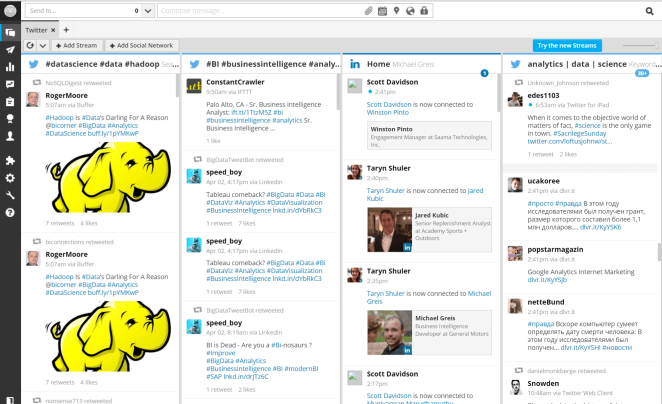
Hootsuite picture.PNGOnce the Twitter, LinkedIn, and WordPress accounts have been added to Hootsuite, all the standard streams that would be available on the separate sites are available within Hoosuite, in one page. There is also an extremely useful feature where pre-selected search terms and hashtag streams from Twitter can be added, which saves me time on typing out “data” and “BI” repeatedly. That’s a check on the first use case.

Analytics

Hootsuite comes with a few pre-built reports for Twitter, WordPress, and LinkedIn, but custom reports appear to be were the real power is. Using a custom template, a single page that combines different measures, charts and graphs from multiple webpages into one report can be made.

As a side note, it appears that there is a severe limit when using the free tier. Building one report used up all the resources I was allocated for the month…So unless all the analytics needs fit into a single report, I will have to start paying. Definitely not a plus…

Hootsuite Report

Beautiful Reports

Hootsuite had many of the capabilities I expected. Combining different social media streams, aggregating information, building visualizations, etc. seemed to be present in this tool. What I was surprised at was the complexity of the tool and getting it set up with all my accounts. Honestly, I was expecting a more user friendly use product. This may not be entirely Hootsuite’s fault…

Going forward, I’m curious what competitor products are available. Would these other products meet my use case better? A quick search reveals that the social media management space is packed full of products, many of them free. For now, Hootsuite has met one of my use cases I was originally looking to solve. Going forward I full plan to examine different tools, and choose a tool that is…freer? Also being compatible with more websites would be a plus.

Who You Should Hire

Every person is hired to perform or deliver something that you value. Considering the simplicity of this statement, why is it so hard? Why do large companies continuously hire dead weight?

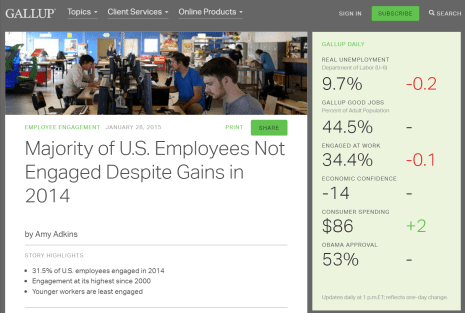
It may sound like these are baseless questions, but looking at the numbers there is a serious problem with the talent that companies are hiring. In a macro analysis study by Gallup, 68.5% of employees were found to be disengaged at work. What does this mean? Gallup State of the American Workplace.PNGThat means in the US if you manage a team of 10 people or have 9 coworkers, almost 7 of those people will be “dead weight” employees. This means that these employees are “…essentially ‘checked out’. They’re sleepwalking through their work day…” Even worse, of these 7 employees, 1-2 of these employees will be actively disengaged. These actively disengaged employees cost US business an estimated $450-$550 BILLION a year.
So how can hiring this dead weight be avoided?

The biggest indicator of how someone is going to perform is based upon two things. Personality and willingness to learn. Identifying the personality traits that are needed in the job and sussing out a potential candidate’s personality is up to the person hiring, but with a shift in thinking and process can be done more effectively.

Make a Biography

At the end of the day, hiring someone just based upon interviews is flawed. With the candidate sitting in front of you most likely trying to sell themselves, how can we get to the core of someone’s personality and goals to ensure that they align to the organization?

According to Praxent’s Tim Hamilton, adapting the methodology from Who, the goal of an interview process should be to gather as much data on a candidate as possible. The focus should be on a broader scope than the professional life or face that is put forward in an interview. By asking about the details of someone’s past and constructing a story of the overall trajectory of an individuals life, trends and characteristics can be found that reveal personality traits that a person may not be explicitly aware of (or unwilling to reveal). The more data points that are able to gleaned from the gathering of this biography, the more confident that you can be that the person who you are interviewing has the personality traits that the team needs. By the time an individual is going through the hiring process, it is reasonable to assume that the personality of the individual is relatively solidified so the usefulness of the biography should be high. If a candidate doesn’t have the right personality now, it is unlikely anyone will be able to change or mold the candidates personality once hired.

Importance of Learners

From the details presented here (and other research), the finding is that all the types of employees learning on the job had a high correlation to job performance when compared to other variables. The implication? Hiring individuals who can and want to learn is the most likely way to hire top job performers. This may seem obvious, but what is not correlated to job performance and how does that match up to the regular hiring process?

Picture of Job Performance PredictorsThe correlation of job-performance with experience is .18 in this study, and in other studies as low as .03. Meaning that one of the most highly weighted factors (experience) that is brought in to asses candidates is not the most predictive of job performance.

If an organization conducted the best interview process ever and hired the most experienced and educated individuals, the hiring would be relying on a flawed methodology that doesn’t accurately account for and weigh the real predictors of job performance.

So what can we do?

Rely on measuring what is proven to lead to high job performance in the hiring process. Don’t heavily weigh an applicants experience other than to ensure the required technical skills. Ensure that the candidate has a goal and personality fit with what is needed for the position. Create an organization comprised of learners. Construct a biography, ascertain personality traits from this, and determine whether the candidate is willing to learn based upon their personality and goals. This may not be a sure-fire methodology, but it seems to be the best way currently available to ensure that the billions of loses incurred every year due to disengaged employees will not include a contribution from your organization.

Why Storytelling is Required

Storytelling and marketing is something that seems to be undervalued by technical individuals in the information technology field. The reason why I’m talking about this? Recently at SXSW in Austin, Contently hosted a talk where Shane Snow discussed the power of storytelling. While the audience attendance was a definitely skewed towards the marketing industry, the concepts that were presented can be applied to any idea or presentation that technical people are trying to sell to customers, managers, or co-workers.

Story Continuation

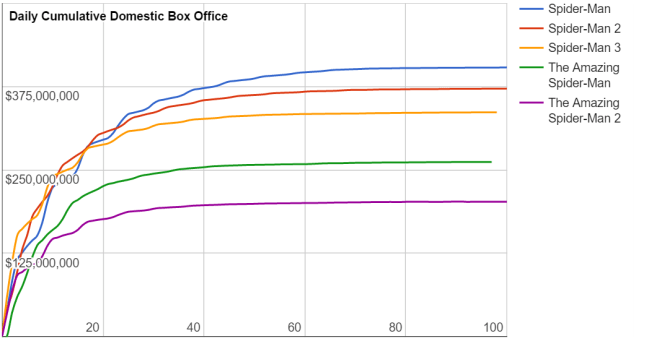
Shane, in his talk, brought up some interesting statistics that prove a powerful point. People tend to gravitate towards stories that build on existing lore and story lines. The area that was pointed to as proving his point? Movies. Shane mentioned a metric that can be used to demonstrate this. Movie revenue. The question is, does Shane’s theory prove true?Spiderman Movie Layout

If you look at the above, grabbed from The Numbers, it clearly shows a relative trend of decreasing sales revenue for Spider-Man movies. On close examination though, the biggest drop in revenue (~15%) when comparing a movie to its predecessor occurred between Spider-Man 3 and The Amazing Spider-Man…When the continuous story line from the first  three Spider-Man movies was broken.

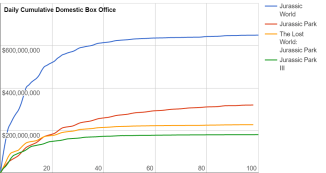
Jurrassic park - Revenue

But…doing some spot checking, also reveals the opposite to be true. Looking at Jurassic Park’s history of revenues, it appears that sequels where the story line is broken can make just as much (or much more). In order to prove out this theory, it appears that more analysis would be needed to prove this point objectively…Maybe this is an oddity with re-boots of classic series?

Regardless, in SOME cases, when movies break from a continuous narrative there appears to be increased risk of people abandoning interest in the movie/idea.

Familiarity

Additionally, Shane mentioned the power of familiarity. When traveling abroad and being around unfamiliar scents, sounds, and tastes, people tend to gravitate towards the known. The perfect example that many can relate to? Beer. Heineken is sold in over 170 countries. When someone is given the choice between a familiar brand that may even be disliked and an unfamiliar brand, people generally choose the known brand that has familiarity. Thinking about the odd concoctions one might encounter when travelling abroad, what would you rather have?

Complexity of Content

The last point that was presented? The easier that content is to read and understand, the more popular it will be. Mark Twain has books that come up at around a 5th grade reading level according to Scholastic’s system. Even the more modern classics, depending on your point of view, come up at around the same reading level. The lesson? It may make us feel good communicating with big words, but it is not the most effective way to communicate.

So What?

At the end of the day, while these ideas are interesting, what can we learn? Everyone is trying to sell stories every day. In technology/knowledge work, it’s a new design or approach to solve a problem. These strategies can be used to communicate an idea effectively and gain the support of others when combined with logical arguments. Establish a narrative that creates a vision and compelling continuous story line. Do it in a way that anyone could understand, from developers to directors, technical to non-technical. Establish a brand, identifier, or name that people can familiarize themselves with. If technical people peddled ideas that have been implemented half as well as they implement them, it would be to everyone’s advantage. Playing to people’s logic works usually…playing to logic and human nature? Couldn’t hurt.

Uses of YouTube

Well, I’ve done Facebook, so might as well move onto YouTube right? Facebook of course has video, and who will win the YouTube vs. Facebook video showdown is very much up for debate. Due to the tech of both of the platforms being at the top of their game, and the user community of YouTube being just as atrocious as the Facebook there aren’t many surface level differences. So what distinguishes YouTube from Facebook?

How to Videos:

YouTube has always been a great channel for getting to how to videos. Everything from car repairs to software programming videos are on the site. Does the same content exist on Facebook? Let’s see…

This slideshow requires JavaScript.

Comparing the two, YouTube looks much cleaner, and more to the point. I don’t see a “Trending” bar on the right side of the screen, or my Facebook friend’s post as the first result. This may be due to YouTube being owned by Google, but the search results are much cleaner and to the point.

Subscriptions:

In my Facebook post, I mentioned the low quality of content on the Facebook professional groups. With YouTube, the focus isn’t on the social aspect. When subscribing to a channel, all that is presented to the viewer is content from the channel. Due to this, the potential effect that the vapid user base of YouTube could have on getting to the content is minimized. Facebook puts the user community interactions front and center, while YouTube makes you dig to the comments section to interact with the fellow users.

This slideshow requires JavaScript.

I subscribed to three channels, The Economist, Fizzle, and TedxTalks in order to explore a range of topics applicable to my career. While the focus of each of these three channels is different, the general reasoning behind the selections is that I want resources centered around world events and trends, with Fizzle throwing in more specific information on marketing, entrepreneurship, and building a brand. Having targeted content at your fingertips is always a good thing in my book. The other big plus of YouTube? Whatever of these three channels that I navigate to on YouTube, the information is displayed efficiently and the noise present in Facebook is not present.

Establishing an Online Presence:

YouTube offers to host videos for free, so why not take advantage of this…

The other plus? My high school friends aren’t friends with me on YouTube, so this is totally green pasture. Hosting videos on YouTube seems to be yet another location that an online presence can be established that is professionally facing. Overall, YouTube is much more usable and useful for video sharing and sharing non-personal information. I much prefer the subscriptions and search engine of YouTube to Facebook’s clutter.

If you are trying to build a personal brand, or learn about…really anything I guess? YouTube is a great source. Find channels that would be helpful, subscribe, and watch the content in an incredible friendly user interface. Additionally, if the mood strikes, anyone can easily post an elevator pitch to add a more personal touch to their online presence. If I have anything technical to show, or how to videos that I’m going to do, they will be on YouTube. At this point, I’m fully content to be a watcher until I have content that will be enhanced by sharing through video.

The Successes (and Issues) with Snapchat

Before I start this, full disclosure, I’m highly skeptical of the current valuations of some of the new social media companies. Of all of these, I find it hard to believe that Snapchat’s valuation is accurate at $16 billion. While it makes sense that owning the medium where people place there eyes for hours a day is worth a large value as a marketing platform, how can that high of a valuation be justified? Looking at the balance sheet of Snapchat, it appears that companies are willing to pay to get advertising in front of Snapchat users, but not nearly enough to justify the valuation. This brings me to the next question. How does a phone app that a $16 billion company was founded on look and perform?

Snapchat Landing Page

In order to answer this question, I started by signing up for an account. All things considered, they do have a nice landing page and signing up was easy. Download the app, enter an email address, and get started. I created the handle mgreis25 and was instantly opening the app on my phone and inviting to connect with friends who already had Snapchat. The user interface is intuitive, with five simple buttons that are used from the main screen to interact with the app. Straight off the bat there are two main things that make this app a cool and innovative experience.

The Good:

Screenshot_2016-02-11-20-38-42.pngThe first is the medium. The fact that people are interacting almost entirely through pictures and videos makes the communications more relatable and engaging. With over 90% of people in the US having smartphones, why don’t consumers and businesses orient pictures and video into more communications? A five second video is much more illuminating than a 140 character Tweet.
The second big feature delivers more than a twitter hashtag will ever be able to. The ability of the Live Feed compilations to show an event that is currently happening and bring you into the moment to see all the craziness, or ordinariness, at certain events is truly unique. This is unlike anything that I have experienced on a social media platform to date.

The Bad:

The big issue I see with Snapchat is the fact that the content is not permanent. After viewing the Snapchat, you cannot save for viewing later. Did you like what you just saw? Well you won’t be able to view it ever again. While it makes sense considering Snapchat’s somewhat scandalous origin, I’m not a fan.

The Future:

Taking into account the humble origins of the app, the founders and creators need to realize that in order to appeal to a wider market they need to remove the auto deleting post feature. Let the people keep their Snapchats! By having the sender choose whether the receiver is allowed to keep the Snapchat, they will be able to retain the original functionality while gaining new users who want to keep the content that is shared and received.
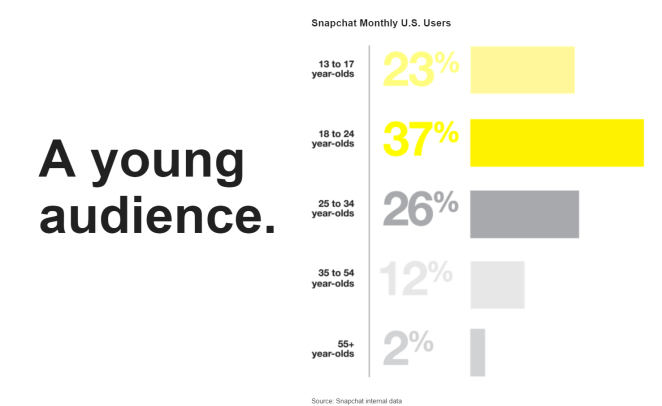
Snapchat DemographicsThe users of this app are primarily between 13-25 and majority female. There has yet to be a foot hold established in the older user demographic. The younger demographics appear to be using this app the best. I have yet to find/hear of a review of the content Screenshot_2016-02-09-18-55-26older users are posting, but older individuals are generally not too fond of Snapchat. Considering the secretive nature of Snapchat content sharing, the entities who are truly using this medium effectively as a marketing platform are the companies that are paying big money to be featured within the app underneath the Discover and Live sections. Snapchat is extremely proud of some of the successes that they have had, an example being the marketing for Fast and Furious. If a user clicks on the bottom right menu, they are lead to feeds for different live events and business entities. Once inside a corporation’s Snapchats, the user has the ability to watch a slew of videos and easily share with friends in one swipe.

Snapchat is a slick application for younger users and can be an effective marketing platform for high paying corporate customers, but I don’t think that valuation of $16 billion is reasonable. With Snapchat retaining no content from the users and only allowing for large companies to broadcast their message, the company is limited on how many paths it can take to generate revenue. Whereas Facebook allows for small businesses to advertise locally by paying on an ad-by-ad basis and gathers vast amounts of personal data, Snapchat does not allow this. At best I see the company rapidly losing value unless the business model changes drastically, becoming a shell of its former self. At worst, Snapchat may die as the user base ages and has less interesting content and time to share with one another, reducing the user base.