Inspiration vs Manipulation

A few weeks ago I was lent a copy of the book Start with Why. The ideas around the use of manipulation vs inspiration to change human behavior is one of the ideas that struck a chord with me thus far. Looking at companies today, there is a clear differentiation in the way that organizations position themselves based upon where they fall with when using manipulation vs inspiration.

Inspiration

These are the companies that get the best employees, deliver innovative solutions, and much of the time have higher margins and growth compared to competitors. How is this achieved? You guessed it. They have a great and inspiring vision of why they do what they do.

spacex mission.PNG

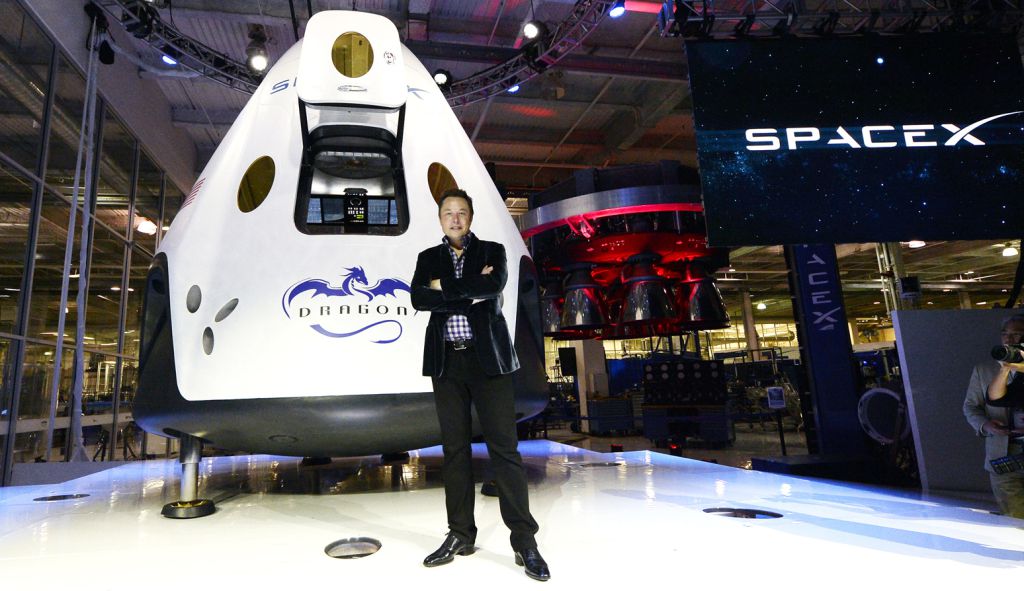
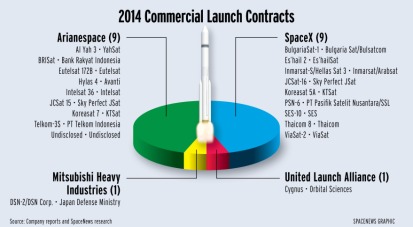
This vision and end goal above is lofty, and certainly something the people (especially rocket designers) can aspire to. Having such a vision for where the company is headed has apparently worked to Spacex’s advantage. Spacex has managed to steal significant market share from the much older Arianespace. There there must be something behind Spacex’s success.
commercial_launchers_web_1.12.151-879x485

The focus on a lofty vision of “why” an organization does what is does not only drives profits, but also clear and concise decision making and motivations for all who are involved with the company. Driving behavior towards a goal that is inspiring and internally motivated is much more effective in the long-term  compared to manipulations.

Manipulation

Price, promotions, fear, aspirations. These are the tactics that are potential changers of human behavior. When making use of these strategies, a company has most likely lost sense of why it exists. The reason for this? When a company is offering to cut price, or market to customer aspirations, there is no longer an internal motivating factor that drives the company. The company compass for decision making has been lost.

The great (or terrible depending on your perspective) example of this is General Motor’s use of promotions to drive sales. In the 1990’s General Motors, along with other US auto manufacturers relied on offering of sales incentives to retain market share when faced by an onslaught of foreign automakers. By taking this route, the US automakers effectively weakened their brands. This may have allowed the automakers to retain higher market share short-term, but it obviously didn’t help the long-term growth and profitability of the company.

Manipulations create addictions for companies that may create some short-term value, but it is at the expense of harming the organization in the long-term. The more fear, promotions, prices cuts, and aspirations a company uses to sell products the cheaper the brand perception will be.

Bottom line, knowing why a company exists provides in internal locus of control which has been proven to be a motivating force compared to the use of manipulations. There’s a reason that Apple customer’s pay more than a 20% premium compared to competitor products, and it’s due to knowing why.

Why Storytelling is Required

Storytelling and marketing is something that seems to be undervalued by technical individuals in the information technology field. The reason why I’m talking about this? Recently at SXSW in Austin, Contently hosted a talk where Shane Snow discussed the power of storytelling. While the audience attendance was a definitely skewed towards the marketing industry, the concepts that were presented can be applied to any idea or presentation that technical people are trying to sell to customers, managers, or co-workers.

Story Continuation

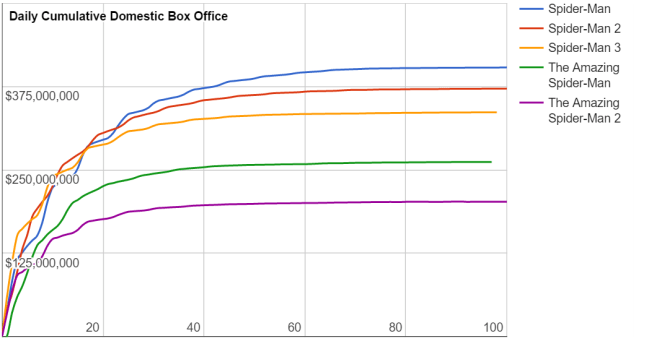
Shane, in his talk, brought up some interesting statistics that prove a powerful point. People tend to gravitate towards stories that build on existing lore and story lines. The area that was pointed to as proving his point? Movies. Shane mentioned a metric that can be used to demonstrate this. Movie revenue. The question is, does Shane’s theory prove true?Spiderman Movie Layout

If you look at the above, grabbed from The Numbers, it clearly shows a relative trend of decreasing sales revenue for Spider-Man movies. On close examination though, the biggest drop in revenue (~15%) when comparing a movie to its predecessor occurred between Spider-Man 3 and The Amazing Spider-Man…When the continuous story line from the first  three Spider-Man movies was broken.

Jurrassic park - Revenue

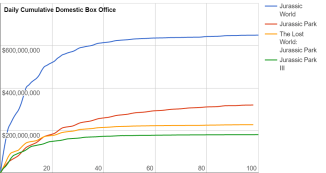
But…doing some spot checking, also reveals the opposite to be true. Looking at Jurassic Park’s history of revenues, it appears that sequels where the story line is broken can make just as much (or much more). In order to prove out this theory, it appears that more analysis would be needed to prove this point objectively…Maybe this is an oddity with re-boots of classic series?

Regardless, in SOME cases, when movies break from a continuous narrative there appears to be increased risk of people abandoning interest in the movie/idea.

Familiarity

Additionally, Shane mentioned the power of familiarity. When traveling abroad and being around unfamiliar scents, sounds, and tastes, people tend to gravitate towards the known. The perfect example that many can relate to? Beer. Heineken is sold in over 170 countries. When someone is given the choice between a familiar brand that may even be disliked and an unfamiliar brand, people generally choose the known brand that has familiarity. Thinking about the odd concoctions one might encounter when travelling abroad, what would you rather have?

Complexity of Content

The last point that was presented? The easier that content is to read and understand, the more popular it will be. Mark Twain has books that come up at around a 5th grade reading level according to Scholastic’s system. Even the more modern classics, depending on your point of view, come up at around the same reading level. The lesson? It may make us feel good communicating with big words, but it is not the most effective way to communicate.

So What?

At the end of the day, while these ideas are interesting, what can we learn? Everyone is trying to sell stories every day. In technology/knowledge work, it’s a new design or approach to solve a problem. These strategies can be used to communicate an idea effectively and gain the support of others when combined with logical arguments. Establish a narrative that creates a vision and compelling continuous story line. Do it in a way that anyone could understand, from developers to directors, technical to non-technical. Establish a brand, identifier, or name that people can familiarize themselves with. If technical people peddled ideas that have been implemented half as well as they implement them, it would be to everyone’s advantage. Playing to people’s logic works usually…playing to logic and human nature? Couldn’t hurt.

What’s Facebook Good For?

Facebook, the worlds biggest social network. Facebook’s main uses for most people include yelling at others over opinions, sharing baby pictures, and other equally important activities that include content from people and companies around the world. The big question, and one that Facebook’s currently trying to make visible, is what are the other uses of Facebook?

For Marketing

There are two main user groups of Facebook for marketing, the first being large companies and the second being individual entrepreneurs running small establishments. It is a completely free way for small businesses to establish an online presence, and for large companies it is another outlet in which they can interact with consumers. With that in mind, anyone who maintains a Facebook page for an entity other than themselves must be aware of both the positive and negative results that can occur.
Thunderbird Facebook Page.PNG
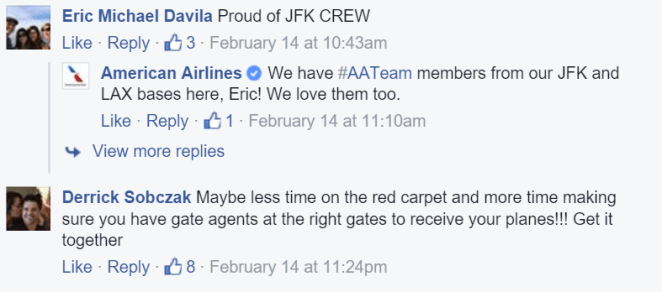
Thunderbird Coffee, a local coffee shop, has a page that is being used effectively. Thunderbird uses this to engage with customers, put a human face on their business, and promote special events which are designed to draw in customers. A small business can use Facebook as an effective and low cost way to get in direct contact with clients. For the larger companies Facebook is a risky way to generate buzz and business. Does the good word of mouth outweigh the negative word of mouth?
American Airlines

For Learning

Facebook appears to have its sights set on making Facebook a resource for professional groups and distribution of articles. While the distribution system is not yet stood up, there are a number of career orientated professional groups that are present on the site. These professional webpages are similar in look and function to LinkedIn groups, with the quality of comments and content being the differentiator between the two.
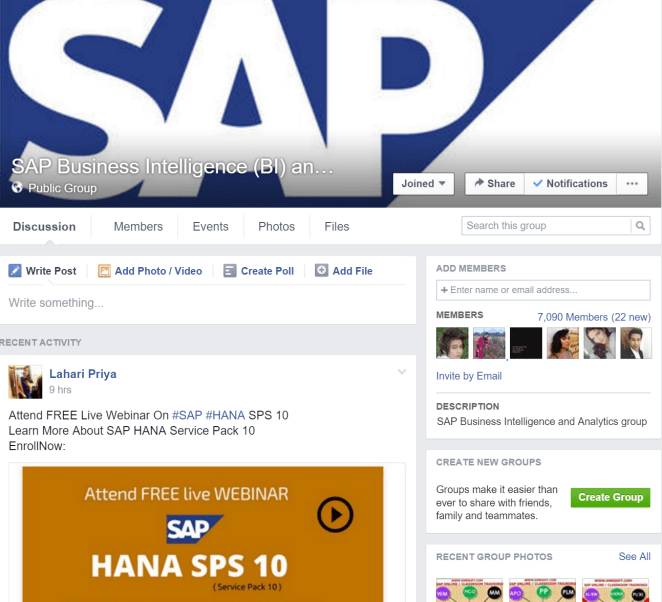
I joined the below SAP group and found many of the comments on the page were individuals plugging themselves or something that they are looking to sell. While this is just one instance of a professionally orientated group on Facebook, the intent of Facebook has traditionally not been for professional purposes. From this experience, it appears that Facebook is going to have to shift the culture of the user base if Facebook hopes to compete with LinkedIn.
Facebook Group Joined.PNG

From Publishers Point of View

Creating a page for a company or organization is extremely easy. Logging in with my personal account and creating a page for a fictitious company took no more than five minutes. This may part of the explanation as to why there are so many poor examples of pages and posts from presumably professional organizations. Unfortunately, while easy to set up, to access some of the features present in these pages, such as analytic dashboards, a page must have 30 likes/follows. Regardless, for a real company Facebook is an excellent platform for advertising and direct company to customer interaction.
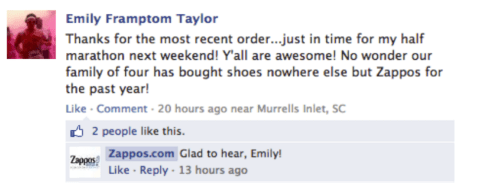
Customer Interactions Facebook
Outside of the business interactions with customers and personal non-professional interactions with friends, Facebook is limited in functionality. It will be a while before Facebook is anything more than an add platform, but Facebook definitely has the ambition and the funds to evolve into an entirely different company than it is today.