Curating With Hootsuite

Hootsuite is one of the titans of social media management software. Hootsuite has clearly had a successful run thus far, receiving $246.9 million of funding from 11 investors in total. You don’t get the backing of major investment firms and over 10 million users of a product purely by luck. The reason I have a sudden interest? Basically it comes down to one thing…curation, which is currently a time consuming process. What do I need?

  1. Simplify the inbound and outbound data feeds I am plugged into. All I want is to spend less time monitoring and looking at social media, while still getting all the information…easy, right?
  2. Have one source for analytics related to my online presence(s).

Simplification

Currently I’m using Twitter, Medium, WordPress, and LinkedIn. After clicking around the website and looking at a few of the training courses, the first criteria can be easily satisfied.

Within Hoosuite’s web-app there is an interface that can be easily used to consolidate some of the sources I identified above. WordPress, Twitter, and LinkedIn can all be consolidated through the use of this tool. Unfortunately Medium is not supported. Three out of four isn’t too bad…
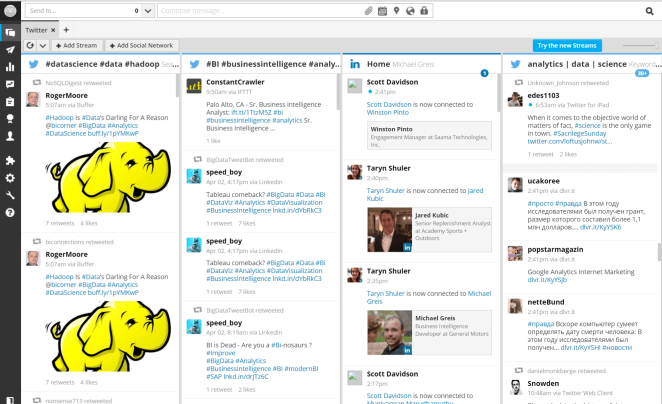
Hootsuite picture.PNGOnce the Twitter, LinkedIn, and WordPress accounts have been added to Hootsuite, all the standard streams that would be available on the separate sites are available within Hoosuite, in one page. There is also an extremely useful feature where pre-selected search terms and hashtag streams from Twitter can be added, which saves me time on typing out “data” and “BI” repeatedly. That’s a check on the first use case.

Analytics

Hootsuite comes with a few pre-built reports for Twitter, WordPress, and LinkedIn, but custom reports appear to be were the real power is. Using a custom template, a single page that combines different measures, charts and graphs from multiple webpages into one report can be made.

As a side note, it appears that there is a severe limit when using the free tier. Building one report used up all the resources I was allocated for the month…So unless all the analytics needs fit into a single report, I will have to start paying. Definitely not a plus…

Hootsuite Report

Beautiful Reports

Hootsuite had many of the capabilities I expected. Combining different social media streams, aggregating information, building visualizations, etc. seemed to be present in this tool. What I was surprised at was the complexity of the tool and getting it set up with all my accounts. Honestly, I was expecting a more user friendly use product. This may not be entirely Hootsuite’s fault…

Going forward, I’m curious what competitor products are available. Would these other products meet my use case better? A quick search reveals that the social media management space is packed full of products, many of them free. For now, Hootsuite has met one of my use cases I was originally looking to solve. Going forward I full plan to examine different tools, and choose a tool that is…freer? Also being compatible with more websites would be a plus.

Uses of YouTube

Well, I’ve done Facebook, so might as well move onto YouTube right? Facebook of course has video, and who will win the YouTube vs. Facebook video showdown is very much up for debate. Due to the tech of both of the platforms being at the top of their game, and the user community of YouTube being just as atrocious as the Facebook there aren’t many surface level differences. So what distinguishes YouTube from Facebook?

How to Videos:

YouTube has always been a great channel for getting to how to videos. Everything from car repairs to software programming videos are on the site. Does the same content exist on Facebook? Let’s see…

This slideshow requires JavaScript.

Comparing the two, YouTube looks much cleaner, and more to the point. I don’t see a “Trending” bar on the right side of the screen, or my Facebook friend’s post as the first result. This may be due to YouTube being owned by Google, but the search results are much cleaner and to the point.

Subscriptions:

In my Facebook post, I mentioned the low quality of content on the Facebook professional groups. With YouTube, the focus isn’t on the social aspect. When subscribing to a channel, all that is presented to the viewer is content from the channel. Due to this, the potential effect that the vapid user base of YouTube could have on getting to the content is minimized. Facebook puts the user community interactions front and center, while YouTube makes you dig to the comments section to interact with the fellow users.

This slideshow requires JavaScript.

I subscribed to three channels, The Economist, Fizzle, and TedxTalks in order to explore a range of topics applicable to my career. While the focus of each of these three channels is different, the general reasoning behind the selections is that I want resources centered around world events and trends, with Fizzle throwing in more specific information on marketing, entrepreneurship, and building a brand. Having targeted content at your fingertips is always a good thing in my book. The other big plus of YouTube? Whatever of these three channels that I navigate to on YouTube, the information is displayed efficiently and the noise present in Facebook is not present.

Establishing an Online Presence:

YouTube offers to host videos for free, so why not take advantage of this…

The other plus? My high school friends aren’t friends with me on YouTube, so this is totally green pasture. Hosting videos on YouTube seems to be yet another location that an online presence can be established that is professionally facing. Overall, YouTube is much more usable and useful for video sharing and sharing non-personal information. I much prefer the subscriptions and search engine of YouTube to Facebook’s clutter.

If you are trying to build a personal brand, or learn about…really anything I guess? YouTube is a great source. Find channels that would be helpful, subscribe, and watch the content in an incredible friendly user interface. Additionally, if the mood strikes, anyone can easily post an elevator pitch to add a more personal touch to their online presence. If I have anything technical to show, or how to videos that I’m going to do, they will be on YouTube. At this point, I’m fully content to be a watcher until I have content that will be enhanced by sharing through video.

What’s Facebook Good For?

Facebook, the worlds biggest social network. Facebook’s main uses for most people include yelling at others over opinions, sharing baby pictures, and other equally important activities that include content from people and companies around the world. The big question, and one that Facebook’s currently trying to make visible, is what are the other uses of Facebook?

For Marketing

There are two main user groups of Facebook for marketing, the first being large companies and the second being individual entrepreneurs running small establishments. It is a completely free way for small businesses to establish an online presence, and for large companies it is another outlet in which they can interact with consumers. With that in mind, anyone who maintains a Facebook page for an entity other than themselves must be aware of both the positive and negative results that can occur.
Thunderbird Facebook Page.PNG
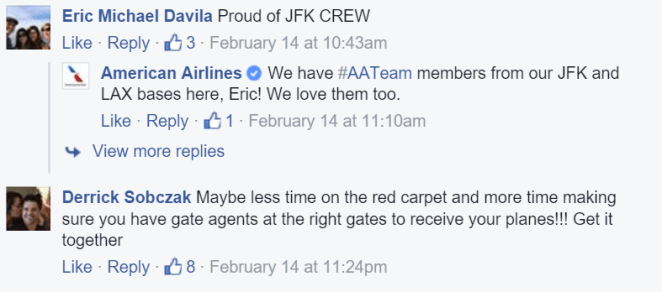
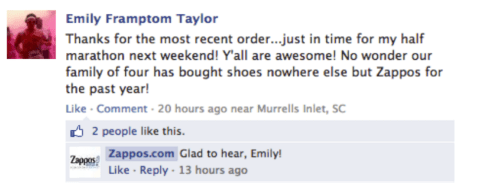
Thunderbird Coffee, a local coffee shop, has a page that is being used effectively. Thunderbird uses this to engage with customers, put a human face on their business, and promote special events which are designed to draw in customers. A small business can use Facebook as an effective and low cost way to get in direct contact with clients. For the larger companies Facebook is a risky way to generate buzz and business. Does the good word of mouth outweigh the negative word of mouth?
American Airlines

For Learning

Facebook appears to have its sights set on making Facebook a resource for professional groups and distribution of articles. While the distribution system is not yet stood up, there are a number of career orientated professional groups that are present on the site. These professional webpages are similar in look and function to LinkedIn groups, with the quality of comments and content being the differentiator between the two.
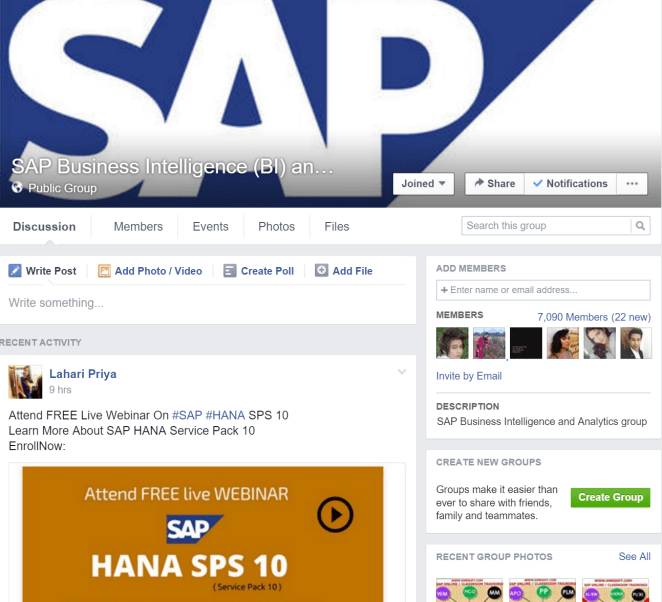
I joined the below SAP group and found many of the comments on the page were individuals plugging themselves or something that they are looking to sell. While this is just one instance of a professionally orientated group on Facebook, the intent of Facebook has traditionally not been for professional purposes. From this experience, it appears that Facebook is going to have to shift the culture of the user base if Facebook hopes to compete with LinkedIn.
Facebook Group Joined.PNG

From Publishers Point of View

Creating a page for a company or organization is extremely easy. Logging in with my personal account and creating a page for a fictitious company took no more than five minutes. This may part of the explanation as to why there are so many poor examples of pages and posts from presumably professional organizations. Unfortunately, while easy to set up, to access some of the features present in these pages, such as analytic dashboards, a page must have 30 likes/follows. Regardless, for a real company Facebook is an excellent platform for advertising and direct company to customer interaction.
Customer Interactions Facebook
Outside of the business interactions with customers and personal non-professional interactions with friends, Facebook is limited in functionality. It will be a while before Facebook is anything more than an add platform, but Facebook definitely has the ambition and the funds to evolve into an entirely different company than it is today.