A Framework for Innovation

Creating change. A fun subject, and an admirable goal according the American Ethos and the media our society has spawned. Even though the innovative ideas may go against the grain or the way that things are currently being done, many consider it a virtue to pursue

innovation-vs-no-innovation

The macro effect of innovation on a company

them. With so much positive emphasis on innovation in our culture, why is it so difficult?

There thousands (if not millions) of reasons why this is the case and I couldn’t hope to answer in a short blog post. Looking at the reverse of that, “how do successful innovations occur?” many insights are available. There are many theories with many names, but reading many of these there is a correlation across the different materials which boil down to two things from what I’ve found and read.

  1. Let people know how the innovation will effect them
  2. Make things easy for the people who are going to be using the innovation

Switch lays out the best framework (in my opinion) for accomplishing these two goals.

Framework for Change

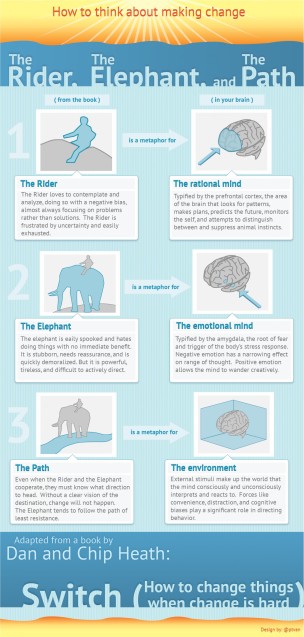
The basic idea is conveyed through the idea that every person can be pictured like a rider on a top of an elephant going down a trail. In order to change where the rider is going to end up, there is the ability to alter three things. You may have guessed it. We can change the rider, the elephant, and the trail.

The Rider: In the idea of the rider and the elephant, this is the logic. Everyone has logic (although some riders may be weaker than others) that helps to form how they behave. The rider’s the part of the person who when starting a new habit, like running in the morning, will cause people to set an alarm.

the-rider-the-elephant-and-the-path_50290b0771b02_w1500.pngThe Elephant: Emotions and subconscious drive. At the end of the day, the elephant dictates where the rider is going to go. The average ~150 pound rider will only be able to control a 13,000 pound animal for so long before coming exhausted.

The elephant is the reason why the planned morning run will be cancelled by multiple pushes on the snooze button. The  elephant is also the reason why people work 90 hour work weeks and are excited to do so.

The Path: The final component for creating change is the external environment in which every individual operates. These are the external forces which effect behavior. Shaping the external forces and how they act upon elephants and their riders, getting the rider to move towards the desired end location.


All in all, it’s pretty straightforward right? Well, it is definitely much easier to conceptualize and talk about then it is to implement. So many people fail, myself included, to implement all three at the same time, leading to great ideas being dropped to the wayside.

For those who want to change things for the better, hopefully this framework can help you get to actualization of innovation.

Down with Vertical Database Architecture

The goal of gathering data can be broken down into a combination of any of the following free. Understanding what has happened, what is happening, or project what will happen. When getting answers to these questions, as long as the answer is obtained, why does it matter how the answer was obtained?

Getting a view into this information can be done many different ways, and with the products available on the market can be done for free and with minimal IT know how. There is a time and a place to pay a premium on IT projects to obtain the capabilities that Skyscraper_Diagramnone of your competitors will have. When a solution needs to be scale-able and tailored to your unique needs.

This is when architecture comes in.

Just like any structure, a database architecture can be flat or tall. What is the difference? To
run with analogy of comparing database architecture to buildings, a skyscraper (vertical) is much more complex to build and maintain compared to a house (horizontal).

Horizontal

A horizontal architecture can be pictured like a suburb. This translates to a house that is commissioned by you that is easily customizable and suited to your needs and wants. Do you want a pool? Easy. Do you want a larger living room or a smaller kitchen? That can be done.

Taking this analogy from building skyscrapers to databases, a flat architecture means that your data is displayed from a single (or as few as possible) levels. It is much easier to understand how the wiring, plumbing, lighting, etc. were put into a house when compared to a skyscraper. Additionally, when you want to install a pool, it’s much easier to install and maintain than a pool on the 23rd floor of a high rise.

Architecture Diagram

Vertical

A vertical architecture means many structural layers in the database, and with it comes complexity. The difference between the physical skyscraper and databases? Skyscrapers are generally created when there is no more land to build flat, this law of physics doesn’t apply to databases.

Why would anyone build a vertical architecture than? In my experience time and resource constraints effect (two thirds of the magic time-resource-quality triangle), short-term thinking.

Benefits of Horizontal

  1. Decrease in cost: Less people to maintain complex solutions, and more time spent creating value for you.
  2. Higher quality: More visibility into what is happening where. Instead of having to dive through and learn how everything was built, people playing with the data only have to learn specific portions which they are interested in.
  3. Faster delivery: The final win on a flat architecture, is speed of delivery. By reducing complexity people spend less time learning, and more time creating value. While in the immediate you may save time in the short-term with a vertical architecture, you will pay dearly in the long-term.

Who You Should Hire

Every person is hired to perform or deliver something that you value. Considering the simplicity of this statement, why is it so hard? Why do large companies continuously hire dead weight?

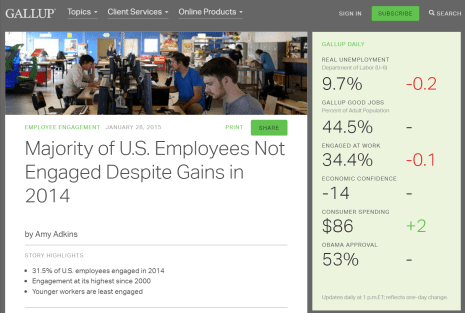
It may sound like these are baseless questions, but looking at the numbers there is a serious problem with the talent that companies are hiring. In a macro analysis study by Gallup, 68.5% of employees were found to be disengaged at work. What does this mean? Gallup State of the American Workplace.PNGThat means in the US if you manage a team of 10 people or have 9 coworkers, almost 7 of those people will be “dead weight” employees. This means that these employees are “…essentially ‘checked out’. They’re sleepwalking through their work day…” Even worse, of these 7 employees, 1-2 of these employees will be actively disengaged. These actively disengaged employees cost US business an estimated $450-$550 BILLION a year.
So how can hiring this dead weight be avoided?

The biggest indicator of how someone is going to perform is based upon two things. Personality and willingness to learn. Identifying the personality traits that are needed in the job and sussing out a potential candidate’s personality is up to the person hiring, but with a shift in thinking and process can be done more effectively.

Make a Biography

At the end of the day, hiring someone just based upon interviews is flawed. With the candidate sitting in front of you most likely trying to sell themselves, how can we get to the core of someone’s personality and goals to ensure that they align to the organization?

According to Praxent’s Tim Hamilton, adapting the methodology from Who, the goal of an interview process should be to gather as much data on a candidate as possible. The focus should be on a broader scope than the professional life or face that is put forward in an interview. By asking about the details of someone’s past and constructing a story of the overall trajectory of an individuals life, trends and characteristics can be found that reveal personality traits that a person may not be explicitly aware of (or unwilling to reveal). The more data points that are able to gleaned from the gathering of this biography, the more confident that you can be that the person who you are interviewing has the personality traits that the team needs. By the time an individual is going through the hiring process, it is reasonable to assume that the personality of the individual is relatively solidified so the usefulness of the biography should be high. If a candidate doesn’t have the right personality now, it is unlikely anyone will be able to change or mold the candidates personality once hired.

Importance of Learners

From the details presented here (and other research), the finding is that all the types of employees learning on the job had a high correlation to job performance when compared to other variables. The implication? Hiring individuals who can and want to learn is the most likely way to hire top job performers. This may seem obvious, but what is not correlated to job performance and how does that match up to the regular hiring process?

Picture of Job Performance PredictorsThe correlation of job-performance with experience is .18 in this study, and in other studies as low as .03. Meaning that one of the most highly weighted factors (experience) that is brought in to asses candidates is not the most predictive of job performance.

If an organization conducted the best interview process ever and hired the most experienced and educated individuals, the hiring would be relying on a flawed methodology that doesn’t accurately account for and weigh the real predictors of job performance.

So what can we do?

Rely on measuring what is proven to lead to high job performance in the hiring process. Don’t heavily weigh an applicants experience other than to ensure the required technical skills. Ensure that the candidate has a goal and personality fit with what is needed for the position. Create an organization comprised of learners. Construct a biography, ascertain personality traits from this, and determine whether the candidate is willing to learn based upon their personality and goals. This may not be a sure-fire methodology, but it seems to be the best way currently available to ensure that the billions of loses incurred every year due to disengaged employees will not include a contribution from your organization.

Why Storytelling is Required

Storytelling and marketing is something that seems to be undervalued by technical individuals in the information technology field. The reason why I’m talking about this? Recently at SXSW in Austin, Contently hosted a talk where Shane Snow discussed the power of storytelling. While the audience attendance was a definitely skewed towards the marketing industry, the concepts that were presented can be applied to any idea or presentation that technical people are trying to sell to customers, managers, or co-workers.

Story Continuation

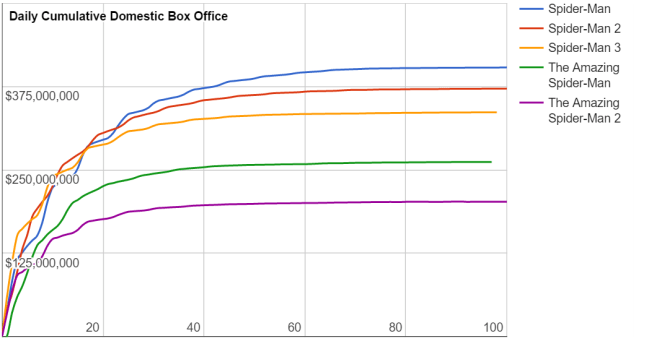
Shane, in his talk, brought up some interesting statistics that prove a powerful point. People tend to gravitate towards stories that build on existing lore and story lines. The area that was pointed to as proving his point? Movies. Shane mentioned a metric that can be used to demonstrate this. Movie revenue. The question is, does Shane’s theory prove true?Spiderman Movie Layout

If you look at the above, grabbed from The Numbers, it clearly shows a relative trend of decreasing sales revenue for Spider-Man movies. On close examination though, the biggest drop in revenue (~15%) when comparing a movie to its predecessor occurred between Spider-Man 3 and The Amazing Spider-Man…When the continuous story line from the first  three Spider-Man movies was broken.

Jurrassic park - Revenue

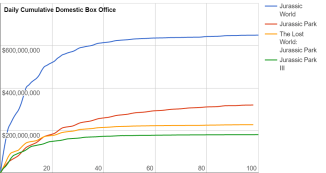
But…doing some spot checking, also reveals the opposite to be true. Looking at Jurassic Park’s history of revenues, it appears that sequels where the story line is broken can make just as much (or much more). In order to prove out this theory, it appears that more analysis would be needed to prove this point objectively…Maybe this is an oddity with re-boots of classic series?

Regardless, in SOME cases, when movies break from a continuous narrative there appears to be increased risk of people abandoning interest in the movie/idea.

Familiarity

Additionally, Shane mentioned the power of familiarity. When traveling abroad and being around unfamiliar scents, sounds, and tastes, people tend to gravitate towards the known. The perfect example that many can relate to? Beer. Heineken is sold in over 170 countries. When someone is given the choice between a familiar brand that may even be disliked and an unfamiliar brand, people generally choose the known brand that has familiarity. Thinking about the odd concoctions one might encounter when travelling abroad, what would you rather have?

Complexity of Content

The last point that was presented? The easier that content is to read and understand, the more popular it will be. Mark Twain has books that come up at around a 5th grade reading level according to Scholastic’s system. Even the more modern classics, depending on your point of view, come up at around the same reading level. The lesson? It may make us feel good communicating with big words, but it is not the most effective way to communicate.

So What?

At the end of the day, while these ideas are interesting, what can we learn? Everyone is trying to sell stories every day. In technology/knowledge work, it’s a new design or approach to solve a problem. These strategies can be used to communicate an idea effectively and gain the support of others when combined with logical arguments. Establish a narrative that creates a vision and compelling continuous story line. Do it in a way that anyone could understand, from developers to directors, technical to non-technical. Establish a brand, identifier, or name that people can familiarize themselves with. If technical people peddled ideas that have been implemented half as well as they implement them, it would be to everyone’s advantage. Playing to people’s logic works usually…playing to logic and human nature? Couldn’t hurt.

Why is IT Always an Issue?

“IT sometimes forgets that we are a car company, not a tech company.”

I’m not quite sure how many people have heard a similar statement from clients (replace car with any product). Never before had I heard a statement that so neatly wraps up the issues and frustrations that I believe many people have with IT.

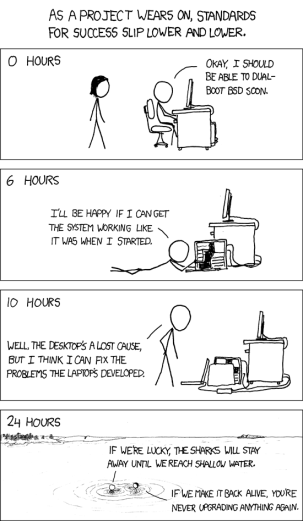
IT ComicWhat’s the core of the issue? IT is seen as a blocker and difficulty rather than an enabler. Why can’t things be simpler, or easier? Why does it take so long to do what I do now in excel with a few clicks? These are all valid questions. The easy answer? You don’t understand what we are accomplishing here and the implications of what you’re asking, delivered in an appropriate tone.
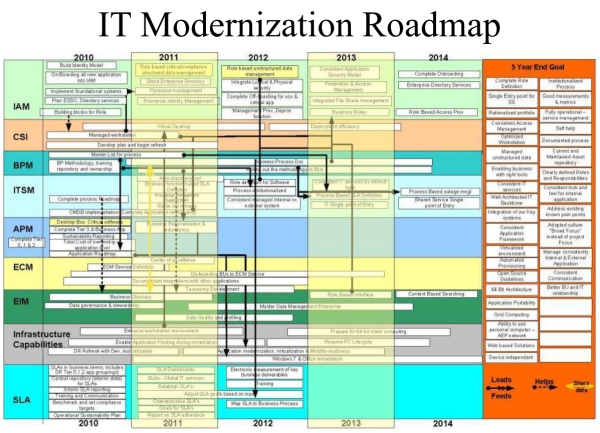
At the end of the day results are what matter. There isn’t a 100% clear solution to the issue of IT organizations and departments consistently not meeting expectations, but in order to keep clients and customers happy there is one clear action that can be done. Communicate with the client and don’t surprise them with bad news. There are countless articles on how to solve this communication divide and deliver bad news, but at the center of any project or product people delivering intangible software products need to shift the conversation from “can’t be done” to discussion of what can. At the end of the day, explaining how something can’t be delivered is not a conversation that will create a situation where any part wins. What will, is establishing realistic and deliverable goals that will assist in solving the pains of the client.

bad-powerpoint-slides

Clear communication from IT

IT may not be the business of a company, but IT should be the ones opening up new paths for a company to walk down. Not obfuscating the path to a smarter and more efficient business.